The heavy-duty 20 mm build-up — twice the aggregate and twice the binder of the pedestrian system. Natural stone laid in one continuous plane across the whole driveway: no joints to open up, no blocks to sink where the wheels turn, and rain that drains straight through instead of pooling at the gate.
Where the high-load system goes
One build-up for every surface on the plot that takes a vehicle. What changes between them is the detailing at the edges and the drainage beneath.
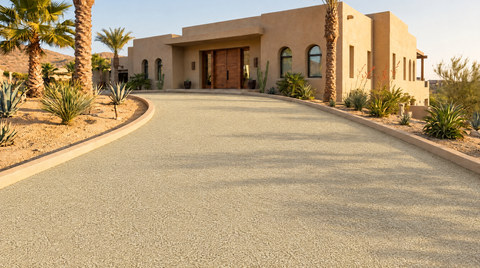
The full run from the gate to the garage, laid as one plane. No block lines to settle, no strip of sunken pavers where the car turns in every day.
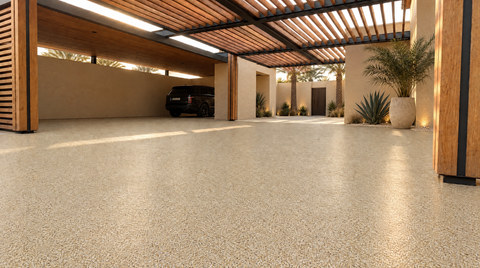
Shaded standing where the car sits for hours. Dust and sand rinse off instead of grinding into joints, and oil marks stay on the surface.
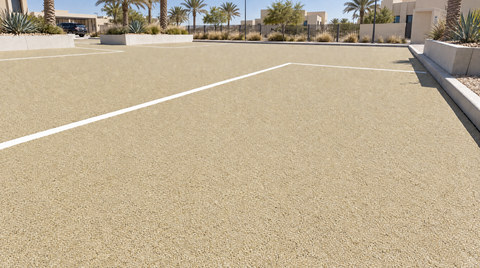
Visitor bays and villa forecourts. Bay markings are set out in a second colour from the same palette rather than painted on top.
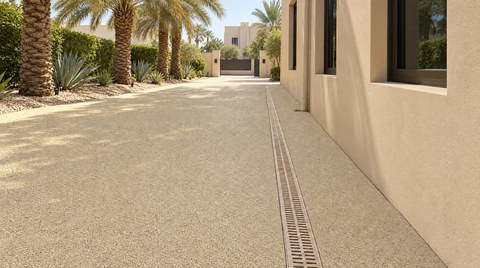
Side runs, bin stores and delivery routes where a loaded van turns on the spot — the movement that lifts interlock blocks first.
Specification
A driveway surface is only as good as the ratio between its thickness and the stone in it. At 20 mm over a 3–5 mm aggregate, this build-up runs at four times the largest stone, where 18 mm and three times the stone size is what the industry treats as the floor for a driveway. The extra millimetres are where the load goes.
Consumption figures below are the ones the calculator uses — exactly double the pedestrian system on aggregate and binder.
Before the stone goes down
Resin bound surfacing is a wearing course, not a structural slab. It spreads load and takes up small movement, but whatever is underneath still does the carrying — which is why the base is checked before a single bag is opened.
Block or concrete edging is set before the surface is laid. The whole plane presses outward under a turning wheel, and the edge is where that force ends up.
Joints in the slab are carried through the surface, never bridged. A joint that is covered over will reappear as a line in the stone, usually within the first summer.
Residual moisture is measured before priming and the base is swept clean the day before. Dust under a polyurethane binder is the commonest reason a driveway lets go early.
What the system consists of
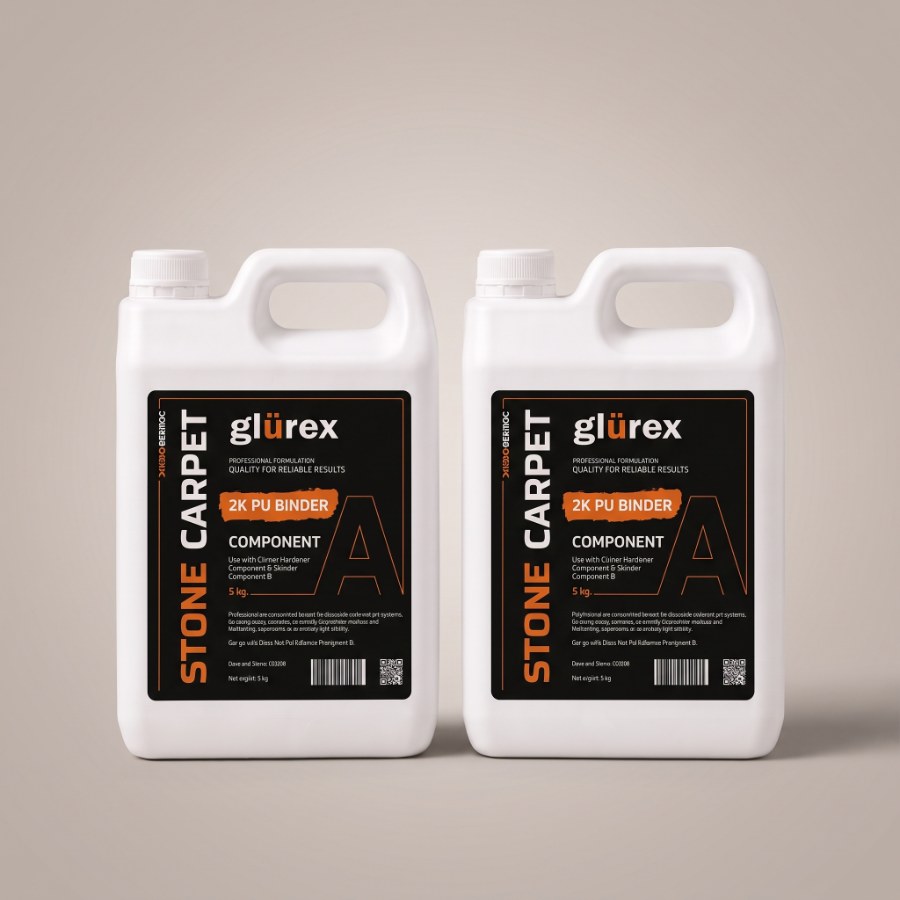
2K Epoxy Primer on absorbent, smooth or sealed concrete: spread thin, broadcast with quartz sand, left to cure, then the loose sand is swept off so the binder keys into a stable surface. The cured primer is a closed film — water that passes through the stone carpet runs off along the falls. On a driveway it is never skipped — the load goes through this bond.
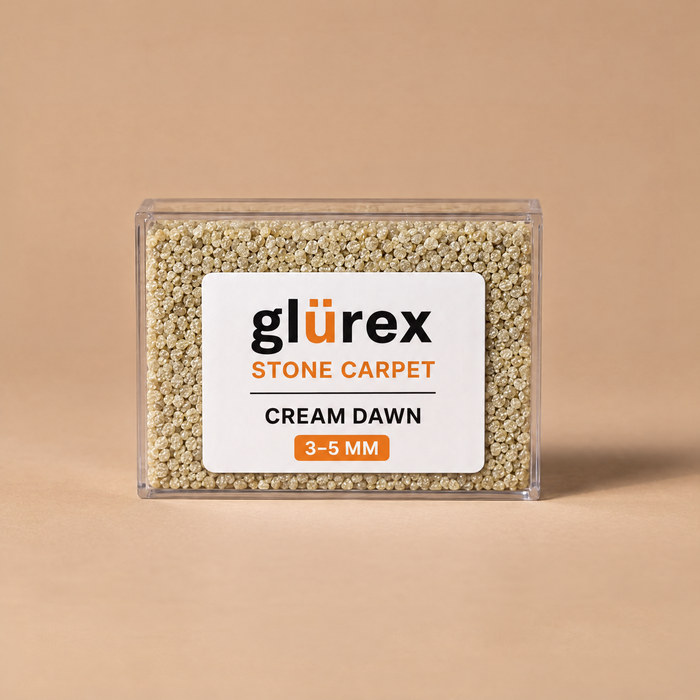
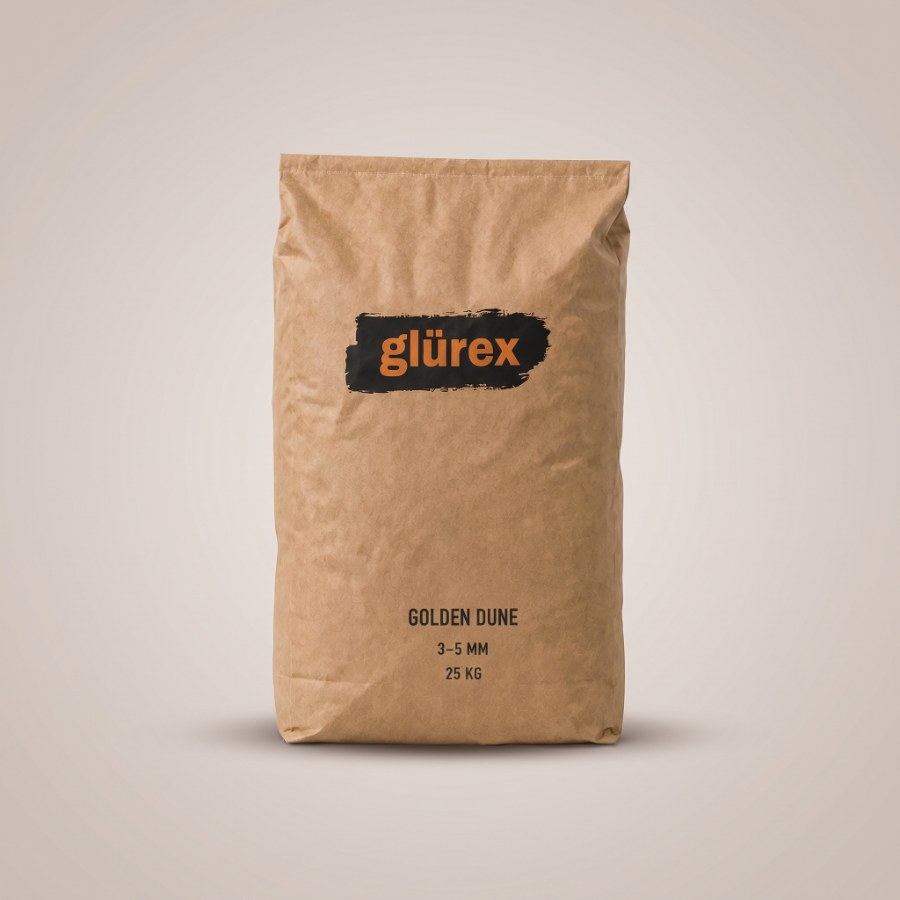
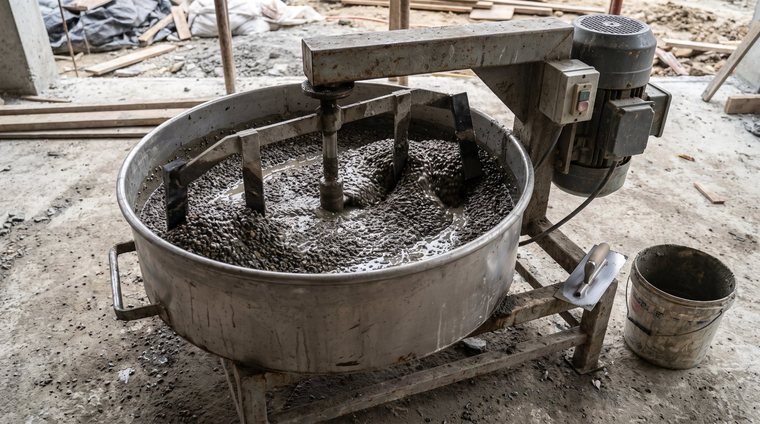
3–5 mm natural stone mixed with transparent polyurethane in a forced-action mixer, then trowelled to 20 mm in one continuous pass across the whole area.
Semi-gloss PU or matte acrylic sealer where a closed surface is wanted. On an open driveway it is usually left off — see the next section for why.
Back in use
This is where resin bound beats every poured alternative. Concrete wants a week before a car touches it and a month before anything heavy; this surface is back under the car on the third day.
Surface is firm to the touch and the site is tidied. Keep everything off it.
Light foot traffic. Walk across it, move bins and planters back.
Cars and daily use. Drive on, park, turn — the surface is in service.
Full hardness. Heavier vehicles and long-term parking in one spot.
Figures for typical UAE ambient conditions. Summer heat shortens the binder's working time on site rather than the wait before driving — which is why driveways here are laid early morning or in the evening.
Choosing the finish
The Finish option in the calculator matters more here than anywhere else in the range.
No topcoat. Water drains through the full 20 mm, tyres grip the stone texture, and there is no film on top to scuff under a turning wheel.
For: driveways, parking bays, service access — anything open to the sky
Closes the pores so dust and spills wipe off rather than settling between the stones, with the natural look of the stone. Reduces permeability, so only where the base drains another way.
For: covered carports and garage approaches
Deepens the colour the way the stone looks when wet and stands up to oil drips and turning tyres better than acrylic. Smoother underfoot and under tyre, so it stays under cover and away from ramps.
For: showroom forecourts and feature entrances under cover
Against the alternatives
Most driveways in the Emirates are interlock, stamped concrete or asphalt. Here is where each of them gives way.
| Stone carpet 20 mm · this page | Interlock pavers | Stamped concrete | Asphalt | |
|---|---|---|---|---|
| Joints | None — one continuous plane | Throughout, sand-filled | Control joints cut in | None |
| Water | Drains through the surface | Runs off, sits in dips | Runs off to a gully | Runs off to a gully |
| Weeds and ants | Nothing to root in | Common in the joints | None | None |
| Settlement under a turning wheel | Bonded plane, no blocks to move | Blocks sink and tilt | Cracks at the joint | Ruts and scuffs in heat |
| Over an existing surface | Yes, over sound concrete or asphalt | Full excavation | Full excavation | Overlay possible |
| Colour range | 12 natural stone colours | Fixed block range | Pigment and stamp pattern | Black |
| Repair | Cut out and re-lay, blends in | Replace blocks, colour differs | Patch always visible | Patch always visible |
| Back in use | Cars after 48 hours | Immediately | About a week | 1–2 days |
| — | Other systems: terrace and path system 10 mm · epoxy garage floors | |||
High-Load Areas — questions
We sell material rather than a finished driveway, so the figure you see above is the material cost per square metre in AED. Installation by our team is AED 173 per square metre (AED 165 + VAT), on top of the materials. Because the 20 mm build-up uses twice the aggregate and binder of the 10 mm pedestrian system, material cost per square metre is roughly double — the calculator gives you the exact packs for your area before anything is ordered.
Yes. The system is specified for repeated wheeled traffic: daily cars, SUVs and delivery vehicles turning at the entrance. The 20 mm build-up is four times the largest stone in the mix, where the industry treats 18 mm and three times the stone size as the minimum for a driveway. For anything heavier than a van — trucks, plant, forklifts — send us the loading and we will tell you honestly whether this is the right surface.
Over sound concrete or asphalt, yes — that is the usual case, and it saves breaking out the old surface. Interlock pavers are different: individual blocks move independently, so they are either lifted or capped with a concrete slab first. If the base is cracked, hollow underfoot or sitting on sand, it is corrected before any stone goes down.
Light foot traffic the next day, cars after about 48 hours, and a full week before anything heavier or before parking in one spot for days. Those are the figures for typical UAE ambient conditions; in summer the binder cures faster, which shortens the window for laying rather than the wait to drive.
The surface itself is permeable — water passes through the stone instead of running across it, which is why there are no puddles at the gate and no standing water after irrigation. What the water meets underneath still has to carry it away, so the base keeps its falls and its outlet. On a sealed concrete slab we check that before quoting.
The resin layer is flexible and takes up small movement that would crack stamped concrete. It will not bridge a moving joint in the slab beneath — those are carried through the surface, not covered over. Damage is repaired in place: the area is cut out and re-laid in the same colour from the same batch, and once cured the repair blends in rather than showing as a patch, the way a replaced paver always does.
There are no joints for weeds to root in, which is the common complaint with interlock. Fine sand can settle on the surface in the open; it rinses off with a hose or a low-pressure washer. That is the whole maintenance routine.
Not on a driveway. The stone has to be fully coated with binder in a forced-action mixer — a drill paddle leaves dry spots that fail under a wheel — and a 20 mm layer over 60 m² is laid to a working time. We rent the mixer for projects where the crew knows the material, and we will introduce an applicator for everything else.
We confirm the build-up against your substrate, falls and drainage, and quote delivery to your emirate.