Natural stone as a seamless interior floor. The texture and colour of real stone underfoot, no grout lines anywhere, and a sealed surface that wipes clean — laid at 10 mm straight over existing marble, porcelain or screed, without breaking out the old floor.
Where the indoor system goes
The same stone runs from room to room with no thresholds and no change of material at the doorway. What changes between rooms is the detailing underneath.
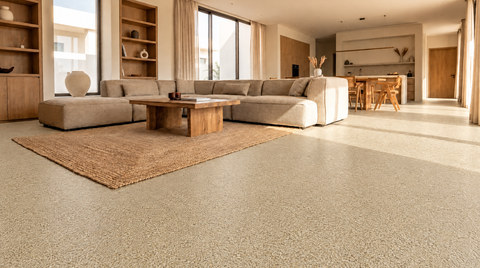
Large open-plan floors laid as one plane. Stone colour and texture instead of a repeating tile pattern, with no grout lines to break it up.
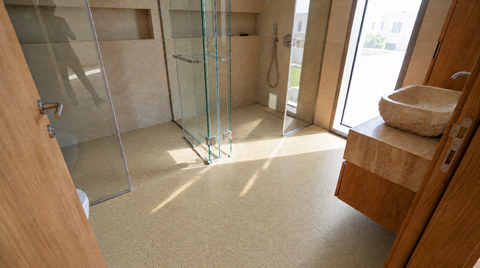
Textured and dry underfoot when wet. Laid over a waterproofing membrane to falls, sealed on top — and not a single grout line to scrub.
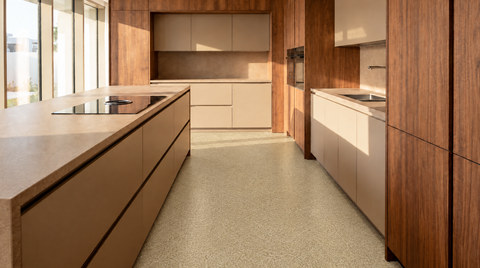
A sealed surface that takes spills and wipes clean. The stone texture hides the everyday crumbs and marks a smooth floor shows straight away.
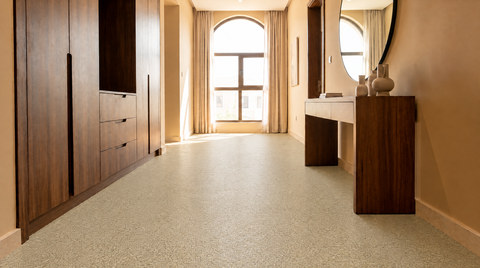
Where sand from outside first lands. Multi-tone stone hides it between sweeps — in villas, lobbies and shop entrances alike.
Specification
The indoor system uses the same stone and binder as the outdoor pedestrian system, at the same 10 mm. The difference is in what goes on top and underneath: indoors the surface is sealed for cleaning, and the base is checked for level, transitions and wet zones rather than for falls to a garden.
Consumption figures are the ones the calculator uses.
Inside and out
No other floor does this. Because the indoor and outdoor systems share the same aggregate and the same twelve colours, the living-room floor and the terrace beyond the sliding doors can be one stone in one colour — sealed inside, open-pore outside, with nothing at the threshold but the door track.
Tile ranges rarely have an outdoor version that truly matches, and smooth floors change at the door: outside they need a different topcoat and a textured finish for grip, so the look is never quite the same.
See the terrace and path system →
Indoor Areas · sealed
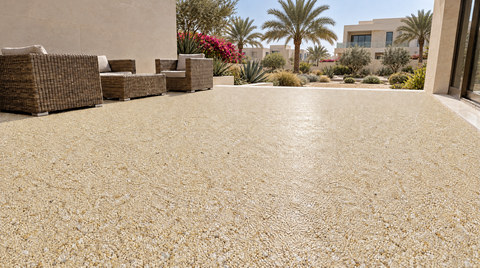
Pedestrian Areas · open pore
Before the stone goes down
Most interior projects in the Emirates are renovations, and most of them start on marble or porcelain that is perfectly sound. The indoor system goes straight over it — the base only needs to be stable, level and dry.
The floor rises by about 10 mm. Doors without enough clearance are trimmed at the bottom, and a thin metal profile finishes the edge where the stone meets another floor.
The stone layer is permeable, so in bathrooms and showers the waterproofing sits beneath it, laid to falls towards the drain. The sealer on top makes the surface easy to clean.
Risers, stair nosings, columns and skirtings take the 8 mm vertical build-up. Treads and landings carry on with the indoor floor.
What the system consists of
2K Epoxy Primer on absorbent, smooth or sealed concrete: spread thin, broadcast with quartz sand, left to cure, then the loose sand is swept off so the binder keys into a stable surface. The cured primer is a closed film.
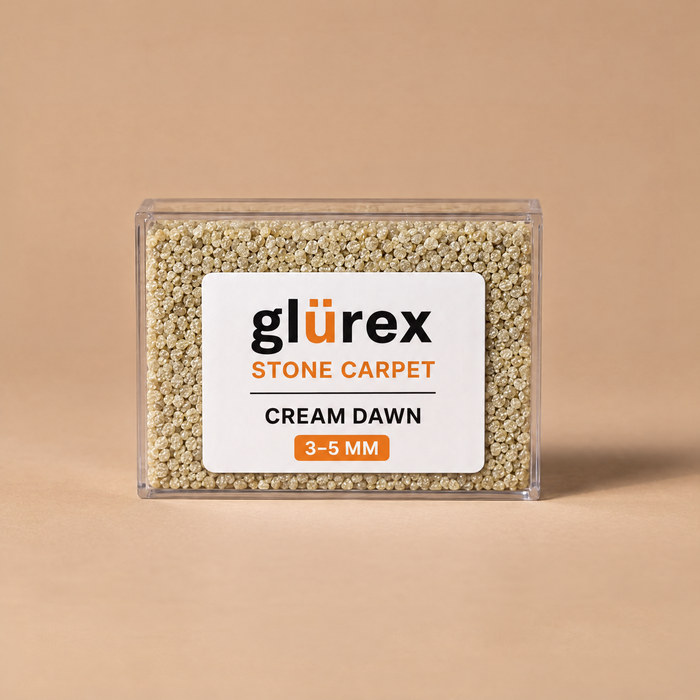
3–5 mm natural stone mixed with transparent polyurethane in a forced-action mixer, then trowelled to 10 mm across the room in one pass.
Two coats of matte acrylic or semi-gloss PU sealer close the surface so dust and spills stay on top and wipe off. Where a fully smooth surface is wanted, PU Sealer (pore filler) goes on first.
Choosing the finish
Outside, an open pore is what lets the rain drain away. Inside there is no rain — only dust, spills and a mop — so indoor floors are sealed by default. It is the Finish option in the calculator.
A closed surface with the natural look of the stone. Dust and spills stay on top; the texture is still there under your feet.
For: living areas, kitchens, hallways, bathrooms
Deepens the colour of every stone and gives the hardest-wearing surface of the three. A soft sheen that picks up the lighting — suited to busy floors and feature areas.
For: retail, lobbies, feature areas
The rawest stone texture and the most grip. Fine dust settles into the pores, so it suits only areas that are rinsed rather than mopped.
For: pool houses, spa wet zones, covered patios
Choosing an interior floor
All four are seamless or nearly so. They are not interchangeable — each one wins in a different room.
| Stone carpet · this page | Microcement | Epoxy | Pebble mosaic tiles | |
|---|---|---|---|---|
| Look | Real stone, multi-tone texture | Smooth mineral, plaster-like | Smooth, uniform colour | Rounded pebbles in grout |
| Underfoot | Textured, grips when wet | Smooth | Smooth, slippery when wet | Bumpy |
| Grout lines | None | None | None | Between every stone |
| Sand and dust | Hidden by the stone tones | Shows on plain colours | Shows on gloss | Collects in the grout |
| Thickness over old floor | 10 mm | 2–3 mm | 1–3 mm | Adhesive plus tile |
| Same floor on the terrace | Yes, same stone and colour | Outdoor build-up, look changes | UV-stable topcoat, look changes | Rarely |
| Walls | Vertical system, 8 mm | Yes | Rarely | Yes |
| Best for | Natural-stone interiors, bathrooms, indoor–outdoor homes | Minimal interiors, walls and floors | Garages, utility, budget floors | Small shower accents |
| — | Microcement floors → | Epoxy for apartments → | Not supplied |
Back in use
No demolition means no dust from breaking out the old floor and no week of waiting for a new screed. The room is usable again almost as soon as the binder has cured.
Walk on it. Keep the room ventilated during laying and for the first day while the resin smell fades.
Furniture goes back, with felt pads under the legs.
Full hardness. Rugs down, normal cleaning, nothing held back.
Indoor Areas — questions
Yes — it is one of the reasons people choose it over smooth floors. The surface is natural stone held in a resin matrix, so it feels textured and dry underfoot rather than slick, including on a wet bathroom floor. Sealed, it is closed and easy to wipe; the stone texture is still there under the foot.
Yes, on the wet-room build-up. The stone layer is permeable, so in a bathroom the waterproofing is a membrane beneath it, laid to falls towards the drain, and the surface is sealed on top. Compared with pebble mosaic tiles there are no grout lines at all — which is exactly where pebble tile shower floors stain, crack and hold water.
Yes, and in UAE villas that is the usual case. Sound, well-bonded marble, porcelain and ceramic tiles are cleaned, any hollow ones lifted and made good, and Glürex confirms the build-up for the old floor after a site visit. Laying over the old floor avoids breaking it out — the dust, the noise and the skip.
By about 10 mm. Most internal doors have enough clearance; where they do not, they are trimmed at the bottom. Where the stone meets another floor finish, a thin metal profile makes the transition. Both are planned before the surface is laid, not discovered afterwards.
Vacuum and a damp mop with a pH-neutral cleaner are enough on a sealed floor. Because the surface is made of stone in several tones, the fine sand that comes in from outside in the Emirates does not show the way it does on a plain, smooth floor. Avoid bleach and acidic descalers — they attack the sealer, not the stone.
Choose stone carpet when you want the texture and colour of real stone, grip underfoot, and the same surface continuing out to the terrace. Choose microcement for a smooth, mineral, minimal look on floors and walls at 2–3 mm. Choose epoxy for a smooth, hard-wearing floor at the lowest cost. The comparison table sets them side by side.
There is a resin smell while the binder is mixed and laid; keep the room ventilated during application and for the first day, and it fades as the binder cures. Walk on the floor the next day, bring furniture back after about 48 hours with felt pads under the legs, and put rugs down after a week.
Yes. Retail floors, hotel lobbies and wellness spaces use the same 10 mm system, sealed for cleaning. In spas and pool houses, where people walk barefoot on wet floors, the texture of the stone is the point. For areas that take trolleys, cars or heavy wheeled traffic, use the 20 mm high-load system instead.
We confirm the build-up against your substrate, falls and drainage, and quote delivery to your emirate.